
October 29, 2026
NEWSLETTER
ACTIVE REFLECTOR: WHERE THE SIGNAL IS NOT ENOUGH
InSAR has become one of the most powerful tools for monitoring ground deformation. It combines millimetric sensitivity with large-area coverage, frequent measurements and the ability to look back in time using historical satellite archives. But InSAR has an important limitation: the satellite needs a sufficiently stable radar signal from the ground.
In urban and industrial environments, buildings, roads and other structures normally provide plenty of stable radar targets. Elsewhere, the situation can be very different. Dense vegetation can strongly reduce coherence, while snow and changing surface conditions can make reliable measurements difficult or impossible.
There may be enough measurement points across most of a site, but too few in one critical location. Or the natural points may simply not be where the measurements are actually needed — on a particular slope, dam, embankment, pipeline or other asset.
In these situations, artificial radar targets can fill the gaps.
The traditional solution: passive corner reflectors
Passive Corner Reflectors (PCRs) have been used for many years to create artificial Persistent Scatterers. Properly installed, they provide a strong and stable radar response at a precisely known location. But there is a practical downside: they are big.
For C-band satellites such as Sentinel-1, achieving the required radar response calls for relatively large metal structures. This makes transportation and installation more complicated, particularly in mountainous and remote locations. Their exposed geometry also makes them vulnerable to snow, heavy rain and strong winds.
They are also no longer necessarily a cheap solution. Large quantities of aluminium or other metal mean significant material and logistics costs. And in some regions, exposed metal structures have another very practical disadvantage: they can be attractive for vandalism or theft because of their scrap value. We have unfortunately experienced this ourselves.
Could the reflector be made active?
Several years ago, our long-standing research partner CTTC set itself a different challenge: could a small electronic device receive the radar signal, amplify it and send it back to the satellite?
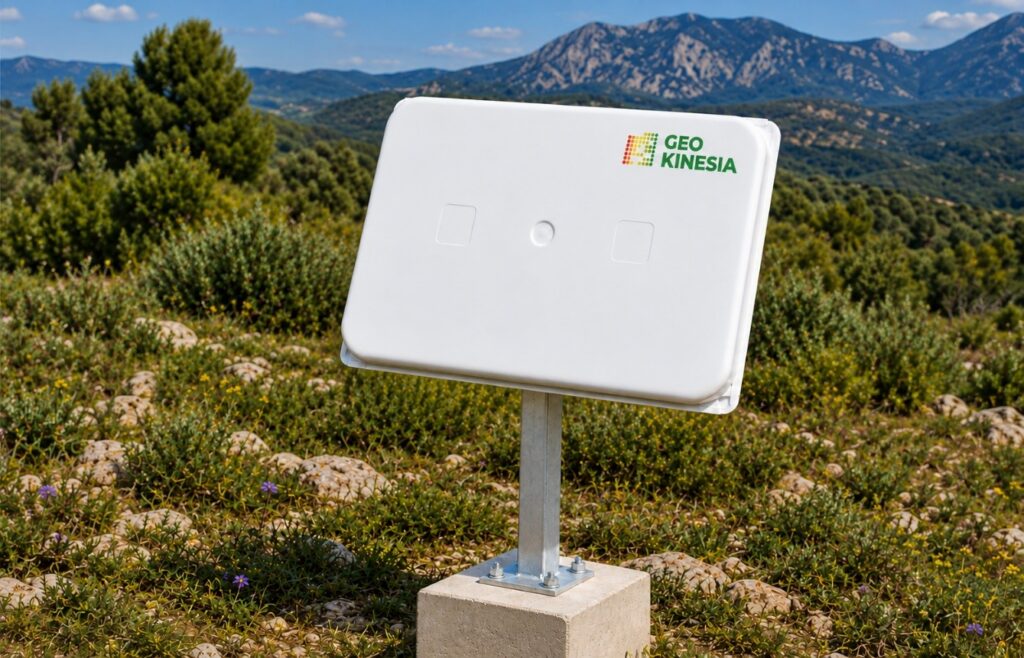
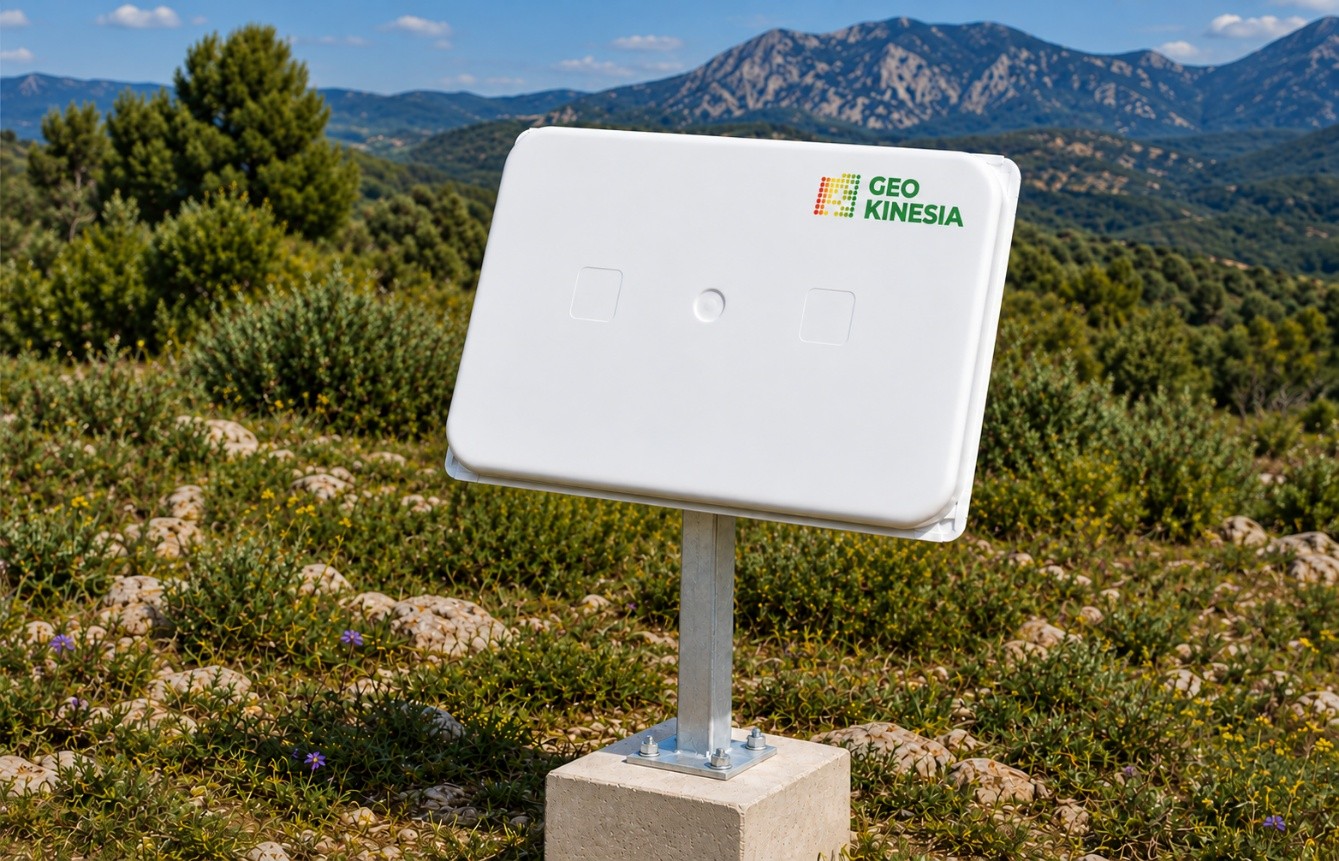
The objective was not simply to build an active reflector. It was to make one that was compact, robust, energy-efficient, cost-effective and sufficiently stable, while remaining practical to install in remote locations. The result was the Active Reflector (AR2), subsequently brought to the market by GeoKinesia.
The principle is straightforward: two antennas receive and retransmit the satellite radar signal, while an RF circuit amplifies it. This allows the device to generate a very strong artificial radar target while remaining substantially smaller and lighter than an equivalent passive reflector.
The original C-band unit measures only 520 × 320 × 70 mm, consumes less than 0.84 W (12 V DC), and produces a radar cross section above 40 dBm². It can operate from a small battery maintained by a solar panel or another 12 V source.
From research prototype to field-proven product
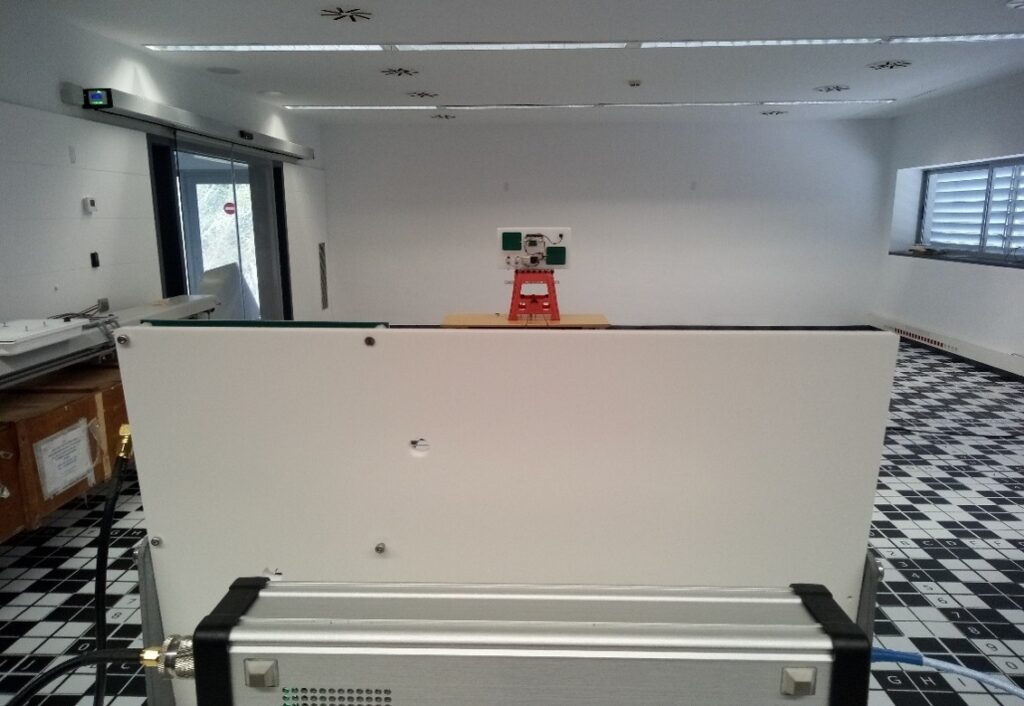
The technology was extensively tested by CTTC in the laboratory and in the field. One published experiment deployed an Active Reflector together with eight passive reflectors on a densely vegetated landslide in the Pyrenees, where natural coherence was poor. The Active Reflector provided the stable reference point required for the InSAR analysis and demonstrated stability of approximately ±2 mm.
Since then, the technology has moved well beyond the research stage, and recently we have seen particularly strong interest in Active Reflectors, with GeoKinesia units being deployed in very different environments across Europe, Africa, Australia and Latin America.
The reasons are practical. Active Reflectors allow operators to put a strong radar target exactly where it is needed, while reducing the size, weight and logistical complexity associated with conventional passive reflectors. They can complement natural Persistent Scatterers rather than replace them, creating reliable measurement points only where the monitoring geometry requires them.
And there is another development ahead.
With the arrival of L-band missions such as NISAR, artificial targets may become even more important. L-band itself substantially improves the ability to obtain coherent measurements through vegetation. But because passive reflector dimensions increase with radar wavelength, conventional corner reflectors become particularly bulky at lower frequencies; active reflectors, by contrast, can remain comparatively compact.
For us, this makes Active Reflectors not simply an accessory to InSAR, but an increasingly useful part of the monitoring toolbox — bringing precise measurements to the places where satellites alone cannot quite provide the full picture.